Climate Change: Environment, Health and Possible Solutions
S. Jit
Department of Zoology, Miranda House, University of Delhi, New Delhi-110007, India.
J. Kaur
Department of Zoology, Gargi College, University of Delhi, Siri Fort Road, New Delhi – 110049, India.
K. Prajapati
Department of Zoology, University of Delhi, New Delhi- 110007, India.
J. Kaur
*

Department of Zoology, Maitreyi College, University of Delhi, Chanakya Puri, New Delhi-110021, India.
*Author to whom correspondence should be addressed.
Abstract
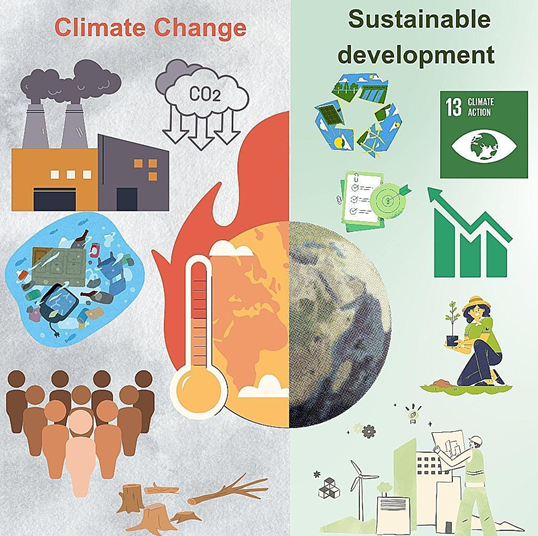
Background: Climate change, evidenced by rising global temperatures, has been a major environmental concern for decades. It impacts ecosystems, agriculture, economies, and social stability, primarily due to greenhouse gas emissions from industrial and urban growth.
Discussion: Climate change reduces agricultural productivity, threatens biodiversity, increases displacement, and widens inequalities. Vulnerable communities face the greatest risks. However, mitigation efforts-such as emission controls, renewable energy, and climate-smart technologies are gaining momentum. Green climate bonds under the UN SDGs are supporting sustainable infrastructure, while environmental indices guide green economic development.
Conclusion: Despite its widespread impacts, climate change can be addressed through integrated global action, sustainable finance, and innovation. A shift toward a green economy is essential for future resilience.
Further Recommendations: Future efforts should prioritize equity, increase climate funding access, invest in local adaptation, and align development with sustainability goals for lasting impact.
Graphical Abstract
Keywords: Biodiversity, environmental sustainability, greenhouse gases, green economy, mitigation strategies