Beyond Overfishing: Environmental Footprints of Modern Fishing Practices and their Implications for Ocean Health
Zubair A A *
PG and Research Department of Aquaculture and Fishery Microbiology, MES Ponnani College, India.
*Author to whom correspondence should be addressed.
Abstract
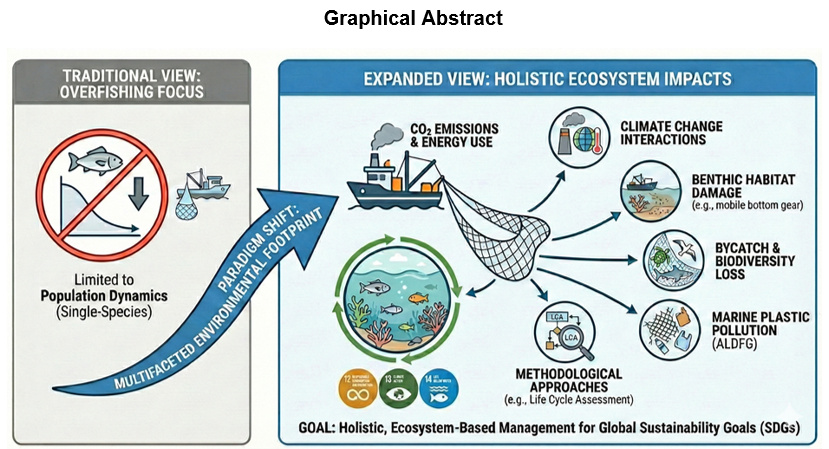
The sustainability of wild captured fisheries has historically been examined through the concept of overfishing. But this limited approach is becoming inadequate. This narrative systematic review synthesizes peer-reviewed literature and institutional reports published between 2002 and 2025, with particular emphasis on studies from 2010–2025, addressing the environmental footprints of marine capture fisheries. The study critically synthesizes the global literature to bring attention to effects that stretch far beyond population trends. It is not limited to carbon and energy footprints, but also extends to the local and global impacts in terms of marine habitat loss, biotic stress on ecosystems and effects at higher levels of biodiversity and trophic structure. There is also a focus on the fishing fleets' high carbon dioxide emissions, which are one of the key but overlooked sources of greenhouse gases. The paper also considers the severe and enduring impact of mobile bottom-contacting gears on benthic ecosystems. Habitat modification, sediment erosion and removal of biogenic structures appear as continuous problems. Simultaneously, the widespread issue of by-catch is considered, and its impact on a wide variety of non-target species including endangered and protected ones. In addition to direct impacts, the review deals with cumulative and indirect pressures related to fishing. These include marine plastic pollution from abandoned, lost or discarded fishing gear (ALDFG). The interaction of fisheries with other anthropogenic pressures, particularly climate change, is also investigated, uncovering multiple and complex feedback loops that compound risk to species. Methodological solutions for measuring environmental footprints are reviewed, with particular focus on Life Cycle Assessment (LCA). The most recent methodological innovations are reviewed and compared with long-standing challenges, concerning data availability, system boundaries, spatial resolution and beyond. Nevertheless, LCA is an indispensable method to make such comparative environmental analyses. The synthesis illustrates a large variability within and between gear types, regions, fisheries. This diversity highlights the shortcoming of one-size-fits-all approaches to management. Context-specific strategies are therefore essential. The review concludes that a holistic, ecosystem-based approach to fisheries management is imperative. This approach will need to build on a sound knowledge of environmental footprints but also conform to global sustainability targets, such as the United Nations Sustainable Development Goals 12, 13 and 14. Aligning these requires a shift from single-species evaluations to holistic methods that fully consider the collective effects of fishing on ocean systems.
Keywords: Bycatch, capture fisheries, carbon footprint, ecosystem-based management, environmental footprint, ghost fishing, habitat impact, life cycle assessment (LCA), sustainable fisheries